Building General Purpose AI II (highly personal approach)
In this blog post, I will not build a GPAI for the readers, unfortunately. That day is not today. Instead, I will try to describe the setting in which the so-called GPAI will have to operate… the setting in which humans operate in the real world. It is important to be able to describe such a setting as accurately as possible since without it we may not build strong beliefs and intuitions for how an intelligent agent ought to operate under the real-world conditions. Without further ado, let me get right into it.
| Axis | Value |
|---|---|
| Learning | |
| Offline – Online/Continual | Online/Continual Learning |
| Supervised – Semi-Supervised – Unsupervised – Reinforcement | Semi-Supervised (+ RL) |
| Passive – Active | Active Learning |
| Single-Objective – Multi-Objective | Multi-Objective Learning |
| Disembodied – Embodied/Grounded | Embodied/Grounded Learning |
| Environment | |
| Episodic – Sequential | Sequential Environment |
| Fully – Partially Observable | Partially Observable Environment |
| Known – Unknown | Unknown Environment |
| Deterministic – Stochastic | Stochastic Environment |
| Single-Agent – Multi-Agent | Multi-Agent Environment |
| Stationary – Dynamic/Non-stationary | Dynamic Environment |
| Closed – Open-ended | Open-ended Environment |
To sum the table above, what I am trying to tell is, (breathing in…) Continual Active Learning with Semi-Supervision for Multi-Objective Optimization for an Embodied Agent Partially Observing in a Sequential and Open-ended Unknown Environment with Stochastic and Non-Stationary Dynamics in the presence of Multi-Agents and Sparse Explicit Rewards (gasping…)
I know: it sounds mouthful, but sometimes there is no shortcut for describing a thing that has become so messy by the process of evolution. Even the smallest details may matter when the process has been running for too long. Emergence is not inherent to the nature, it “emerges” out of our computational limits and how far to the future we can actually see/compute. Everything within our reach is imminent and anything beyond our reach is emergent.
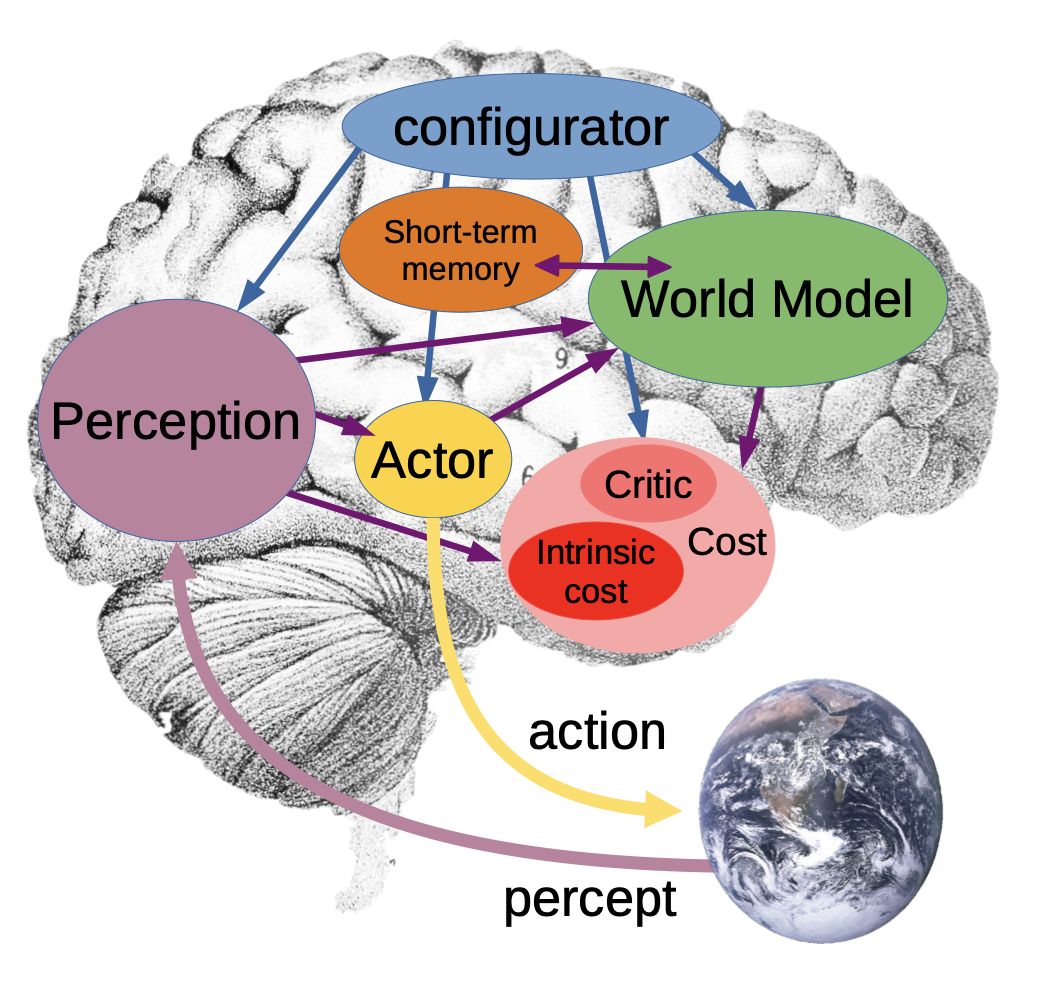
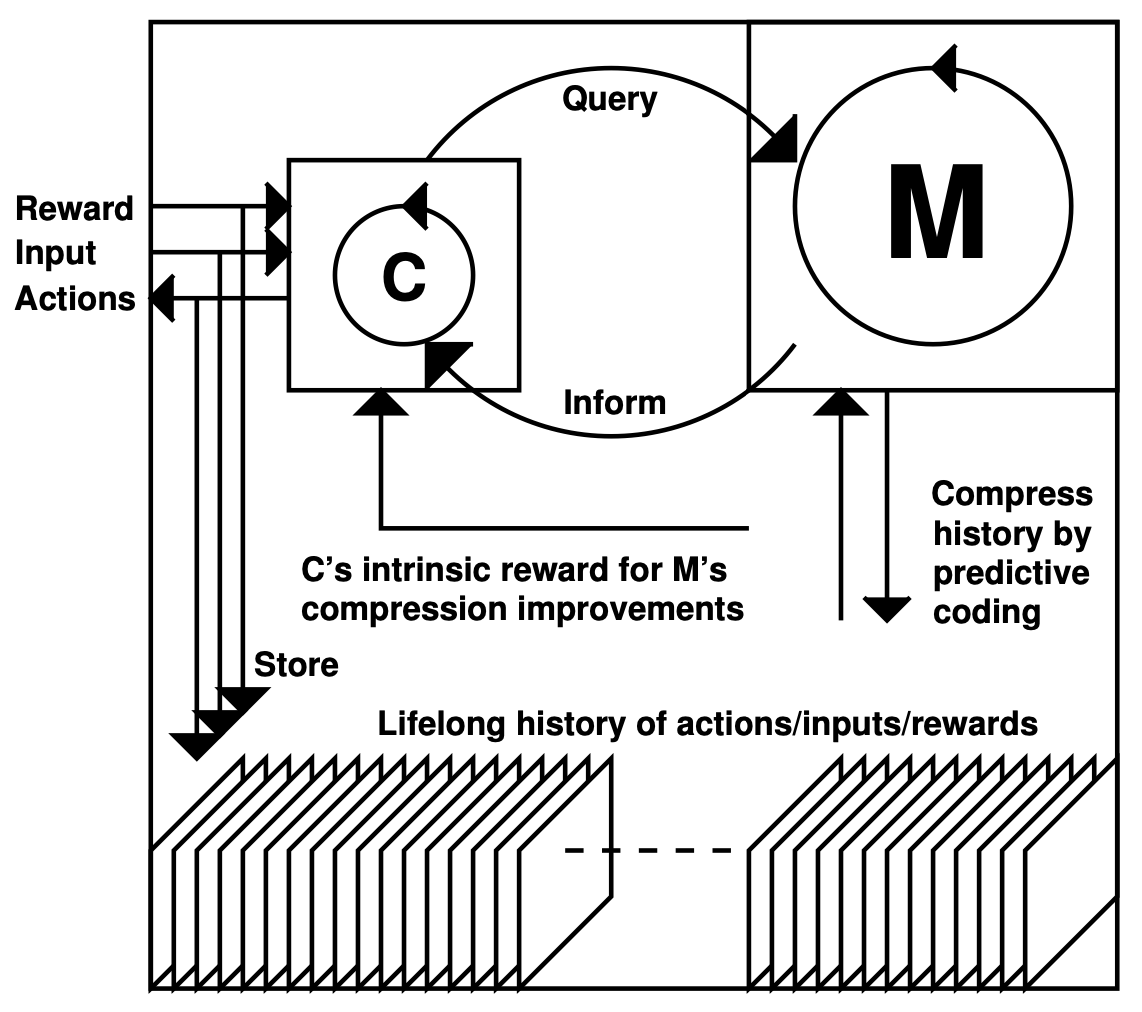
Multiple architectures and approaches for (building) intelligent systems have been proposed by scientists such as Richard Sutton, Yann LeCun, Jurgen Schmidhuber, Markus Hutter. Richard Sutton et al. have proposed the Options and Knowledge (OaK) architecture in The Alberta Plan for AI Research, Yann LeCun has proposed his architecture for autonomous intelligent agents in A Path Towards Autonomous Machine Intelligence, Jurgen Schmidhuber has proposed RNNAI in On Learning to Think: Algorithmic Information Theory for Novel Combinations of Reinforcement Learning Controllers and Recurrent Neural World Models, Markus Hutter has proposed universal AI in A Theory of Universal Artificial Intelligence based on Algorithmic Complexity.
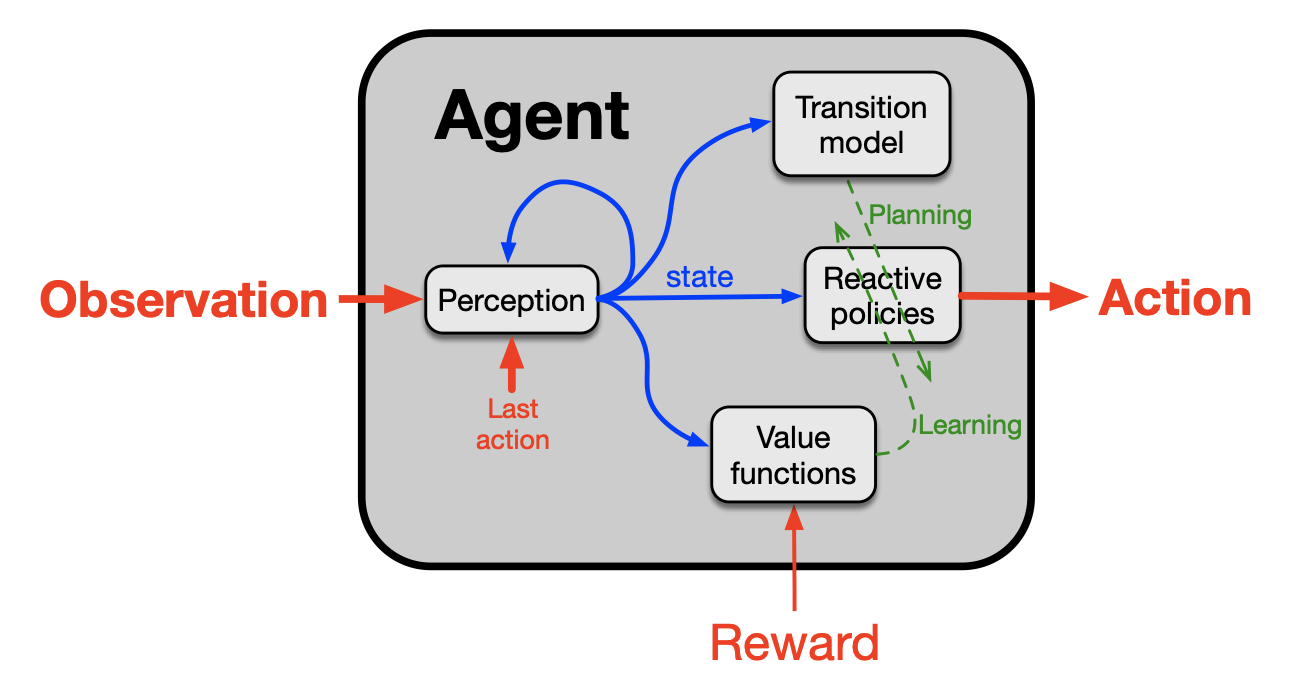

The Alberta plan consists of 12 steps:
-
Representation I: Continual supervised learning with given features.
-
Representation II: Supervised feature finding.
-
Prediction I: Continual Generalized Value Function (GVF) prediction learning.
-
Control I: Continual actor-critic control.
-
Prediction II: Average-reward GVF learning.
-
Control II: Continuing control problems.
-
Planning I: Planning with average reward.
-
Prototype-AI I: One-step model-based RL with continual function approximation.
-
Planning II: Search control and exploration.
-
Prototype-AI II: The STOMP progression.
-
Prototype-AI III: Oak.
-
Prototype-IA: Intelligence amplification.
The objective-driven AI requires constructing world models that leverage joint-embedding predictive architecture (JEPA):
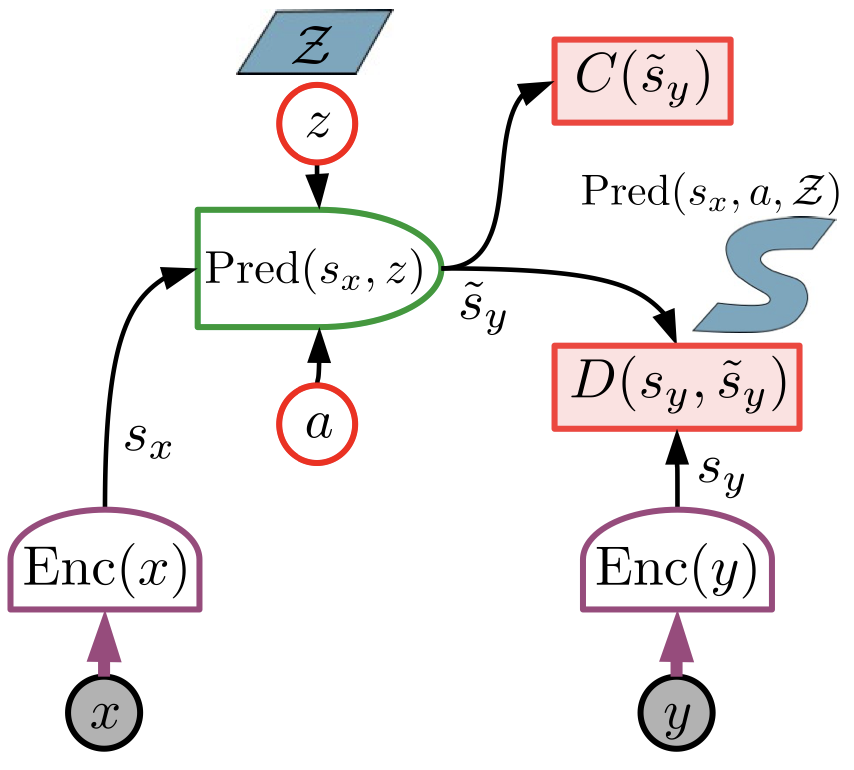
So, what is the conclusion of all this? Alberta plan seems to tackle the right problem, which is continual learning (w/o catastrophic forgetting). Objective-driven AI has several abstract components in the architecture, but it is still unclear to me how the JEPA architecture will be able to learn the model of the world while utilizing fixed memory and staying non-continual. Non-fixed memory/runtime complexity is important because we often (rightfully) assume that the world is always more complex than what one system can model or learn about it. AIXI is a big infinite for-loop brute-forcing through every possible program/hypothesis out there, and, well, no surprises: it is incomputable. However, there is another version, AIXItl (time- and lenght-bound AIXI), that is computable but not really what I am looking for, I guess – it does not have the constructive flavor that I would love to taste, meaning that it states the obvious without being really helpful.